Orchestrating a Fully Automated Chemistry Research Workflow, Acceleration Consortium


Overview
Built and maintained the software backbone for a self-driving laboratory (SDL) — a fully automated chemistry research platform that combines a Universal Robots (UR) arm, HPLC, liquid handling systems, and mass tracking instruments into a single orchestrated pipeline. The goal: run liquid-liquid extraction (LLE) experiments autonomously, guided by Bayesian optimization, with minimal human intervention.
Experiment Workflow
Implemented the human-in-the-loop (HITL) experiment cycle — the core research loop of the SDL:
-
Run Bayesian optimization to propose next experiment parameters
-
Prepare extraction vials with the robot arm and liquid handler
-
Execute the liquid-liquid extraction
-
Verify phase separation via camera feedback
-
Sample top and bottom phases, run HPLC analysis
-
Feed purity and recovery results back into the BO model
Bayesian Optimization Setup
Configured the multi-objective Bayesian optimization pipeline using the Ax platform(Meta's adaptive experimentation framework), balancing the competing objectives of extraction purity and recovery yield across a continuous parameter space.
Perception Informed Autonomous Navigation of a Monopedal Hopping Robot, University of Toronto
This project simulates Hopcopter — a Crazyflie-based monopedal hopping robot — in Gazebo Harmonic. A ROS2 pipeline integrates LiDAR point-cloud processing, OMPL RRT* global path planning, and a multi-criteria local planner that scores and refines candidate landing zones in real time, enabling fully autonomous obstacle-aware navigation. An optional natural-language goal interface (powered by Claude) lets users command the robot in plain English.
Github repo: https://github.com/zweaung1014/rislab-hopcopter
Simulation video: https://www.youtube.com/watch?v=Yvn6zSlEApQ
Hardware demo video: https://www.youtube.com/watch?v=_PuOxqvgZJw
Dynamic Transformation of an Origami String Using a Stacked-Miura Cell (link) - Expeditionary Robotics Lab


Minimizing complexity in actuation is a challenge, but underactuated structures are a promising approach to solving this problem. In this paper, we present a method for actuating an origami string - slender structures that can be mechanically programmed to achieve a specific curvature - capable of multiple configurations using one actuator. By using the snap-through behavior of the stacked-Miura cell, we demonstrate reliable and repeatable transformation of an origami string.


Transformable Quadcopter (unpublished) - Expeditionary Robotics Lab

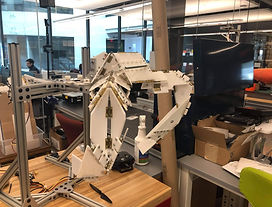
Finding ways to build actuation mechanisms with higher strength-to-weight ratios are an important advancement in building complex transformable structures. However, underactuated structures can also be used to reduce weight. In this project, we mechanically programmed four origami strings to achieve an erect configuration for flying and a curved configuration for driving on the ground and attached them to the stacked-Miura cell. The result is a transformable quadcopter capable of traversing on air and on the ground.
Teleoperated Haptic Hand - Course Project


The ANA Avatar XPrize competition requires teams to build avatars that can be controlled by a user from afar to accomplish a set of tasks. In this project, we build an end effector that can be remotely controlled. We built an end effector and programmed a Raspberry Pi to simultaneously read the position of the controller and control the motor attached to the finger via tendons. However, the project was not completed due to COVID in 2020.